The stairs are often the first real test after a knee injury. If every step feels guarded, weak, or painful, the right movement plan can help you rebuild confidence without pushing the joint too far. The top exercises for knee rehabilitation are not necessarily the hardest ones. They are the exercises that restore motion, strength, balance, and control at the stage your knee is ready for.
A knee may become painful after a twist, a fall, a sports injury, surgery, arthritis flare-up, or months of compensating for hip or ankle weakness. The best starting point depends on the cause of your symptoms. A recent ACL reconstruction, for example, needs a different progression than knee osteoarthritis or a mild patellofemoral pain problem. If your knee is significantly swollen, locks, gives way, looks deformed, or cannot bear weight, seek medical assessment before starting an exercise routine.
How to Choose Knee Rehabilitation Exercises
Knee rehabilitation works best when it follows a clear progression. Early on, the goal is usually to reduce stiffness, regain the ability to straighten and bend the knee, and re-engage the quadriceps muscles at the front of the thigh. As pain and swelling settle, strengthening and balance work become more important. Later, the focus shifts to tasks that reflect daily life, work, stairs, running, or sport.
Use discomfort as information, not a challenge to overcome. Mild muscular effort or a low level of ache during exercise can be acceptable, but sharp pain, increasing swelling, buckling, or pain that remains noticeably worse the next day means the exercise may be too much. Reduce the range, repetitions, resistance, or frequency and reassess.
Move slowly and keep the knee aligned over the middle toes rather than letting it collapse inward. Quality matters more than completing a high number of repetitions.
Top Exercises for Knee Rehabilitation
1. Heel Slides for Knee Bending
Heel slides are a useful early exercise when the knee feels stiff after injury or surgery. Lie on your back with both legs straight. Slowly slide the affected heel toward your hips, allowing the knee to bend as far as is comfortable, then slide it back out.
Start with 10 gentle repetitions, once or twice daily. Do not force the bend by pulling aggressively on the leg. The goal is gradual motion, especially when swelling has made the joint feel tight.
2. Quad Sets for Muscle Activation
The quadriceps can switch off quickly after knee pain or swelling. Quad sets help reconnect that muscle without requiring much joint movement. Sit or lie with the leg straight and a small rolled towel under the knee. Tighten the front of the thigh as if you are pressing the back of the knee gently into the towel.
Hold for five to 10 seconds, relax, and repeat 10 times. You should feel the thigh working and may see the kneecap move slightly upward. This exercise is often appropriate in the early phase, but follow your surgeon or physiotherapist’s specific instructions after an operation.
3. Straight Leg Raises for Controlled Strength
Once you can fully tighten the quadriceps without pain or a lag in the knee, add straight leg raises. Lie on your back, bend the unaffected knee, and keep the rehabilitating leg straight. Tighten the thigh first, then lift the leg about 12 inches off the floor. Lower it with control.
Aim for two sets of eight to 12 repetitions. If your low back arches or your knee bends while lifting, reduce the height or return to quad sets for a few days. A clean, controlled lift is more valuable than a higher lift.
4. Seated Knee Extensions
Seated knee extensions build quadriceps control through a functional range. Sit in a sturdy chair with your feet on the floor. Slowly straighten one knee until the leg is nearly level with the ground, pause briefly, then lower it over three seconds.
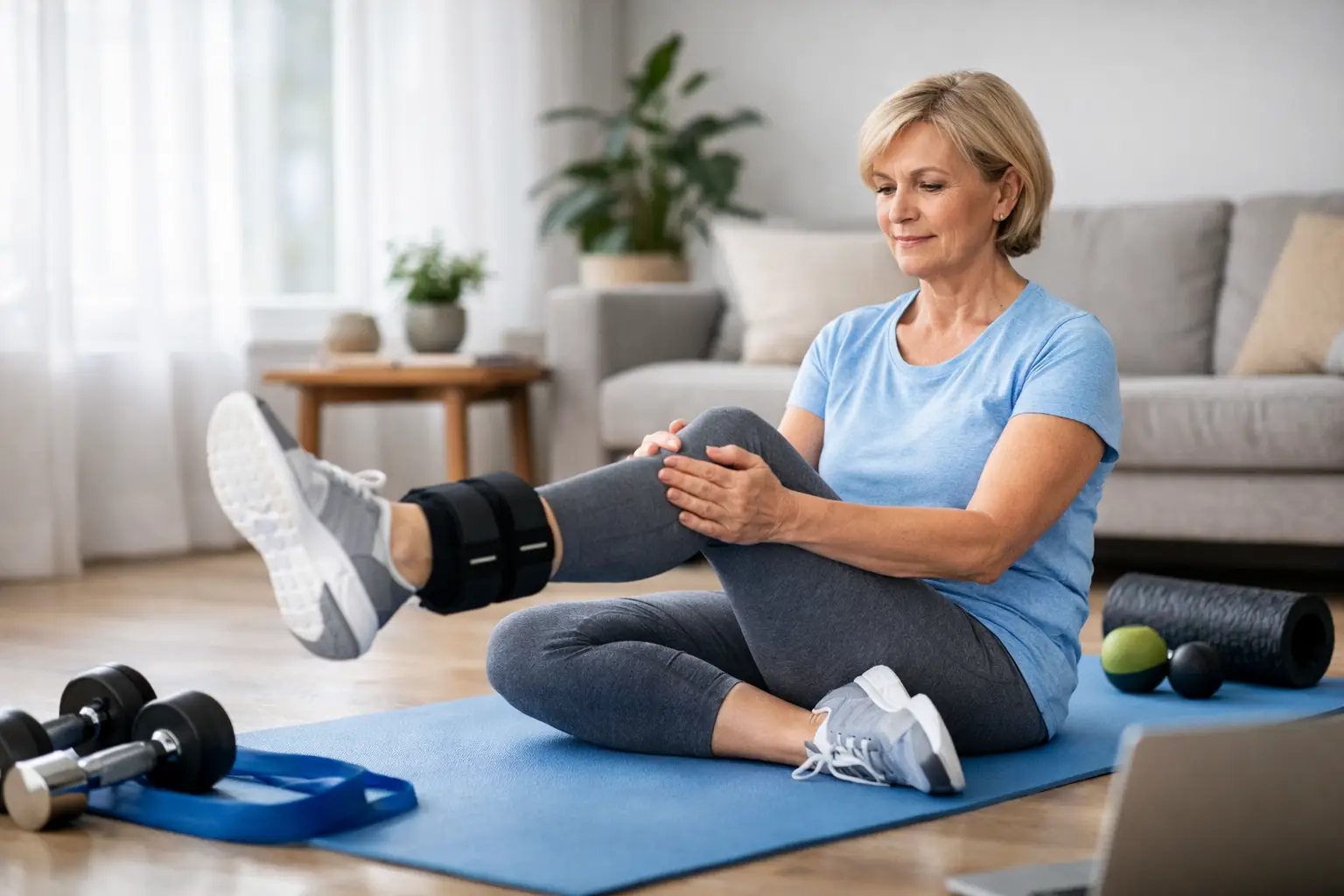
Begin without ankle weights for two sets of 10 repetitions. This can be particularly helpful for people managing arthritis-related weakness, as long as it does not create joint irritation. If pain occurs near the front of the knee, work in a smaller range and discuss the symptom with a licensed professional.
5. Sit-to-Stands for Everyday Function
Standing up from a chair is a practical strength test for the hips, thighs, and knees. Choose a firm chair that allows your feet to rest flat. Scoot toward the front, place your feet hip-width apart, lean your chest forward slightly, and stand without using your hands if possible. Then sit down slowly.
Complete two sets of six to 10 repetitions. A higher chair makes this easier; a lower chair increases the demand. Keep the movement smooth and avoid dropping into the seat. This is a good example of how rehabilitation should connect with daily life, not only with the exercise mat.
6. Supported Mini Squats
Mini squats strengthen the legs while training the knee to handle body weight. Stand near a counter or hold the back of a stable chair. Bend at the hips and knees as though you are sitting back, keeping the knees in line with the toes. Start with a shallow bend, then return to standing by pressing through the whole foot.
Try two sets of eight repetitions. There is no prize for squatting deeply during early rehab. A comfortable, well-aligned partial squat may be the right choice until strength and control improve. For some people with arthritis or kneecap pain, the depth of the squat is the main factor that determines comfort.
7. Step-Ups for Stair Confidence
Step-ups prepare the knee for curbs, stairs, and walking uphill. Use a low step and hold a rail or counter at first. Place the affected foot fully on the step, press through that leg, and bring the other foot up. Step down slowly, maintaining control rather than letting the knee drop inward.
Perform six to 10 repetitions on each side. Increase the height of the step only when you can complete the lower step without pain, wobbling, or pushing heavily through the opposite leg. Step-downs are usually more demanding than step-ups, so introduce them later if descending stairs remains difficult.
8. Calf Raises and Single-Leg Balance
The knee does not work alone. Calf strength, ankle control, and balance all affect how force travels through the leg. For calf raises, hold a counter, rise onto the balls of both feet, pause, and lower slowly. For balance, stand near support and lift one foot slightly off the floor while keeping the standing knee softly bent.
Start with 10 calf raises and three balance holds of 15 to 20 seconds. As control improves, progress to single-leg calf raises or balance on a less stable surface only if it is safe. These small exercises can make walking and direction changes feel more secure.
Building a Safe Weekly Routine
Most people do well with mobility exercises daily and strength exercises two to three nonconsecutive days per week. Begin with a level that feels manageable, then make only one change at a time: add a few repetitions, slightly increase resistance, or use a deeper range. Trying to improve everything at once can flare a sensitive knee.
A simple session may include heel slides, quad sets, sit-to-stands, mini squats, calf raises, and balance work. Start with five to 10 minutes of easy walking or a stationary bike if it feels comfortable. Finish with light movement rather than prolonged rest, especially if stiffness tends to return after sitting.
Ice, elevation, and compression can help with short-term swelling for some injuries, but they do not replace progressive exercise. Likewise, resting completely for too long often leads to more weakness and stiffness. The right balance is relative rest from aggravating activity while keeping the knee moving within a tolerable range.
When Personalized Physiotherapy Matters
Generic exercises have limits. Professional assessment is especially valuable after surgery, a fracture, ligament or meniscus injury, repeated knee giving-way, or pain that has not improved after several weeks. A physiotherapist can assess your walking pattern, joint range, strength differences, hip and ankle movement, and the activities that are keeping symptoms active.
At Active Rehab Centre, a personalized rehabilitation plan can combine hands-on care, progressive exercise, and guidance for returning to work, recreation, or sport. This is particularly helpful when pain in the back, hip, or foot is changing the way you load your knee.
Your knee does not need to feel perfect before you begin rebuilding trust in it. Start with the movement you can do well today, repeat it consistently, and let controlled progress guide the next step.